Graduate Fellowship Program in Politics and Government
An interdisciplinary certificate program open to graduate students in all Rutgers schools and disciplines who would like to further an interest in American politics and government.
APPLY NOW for the 2024-2025 Eagleton Graduate Fellowship Program. March 25th at 5:00 pm EST is the deadline for applications and recommendation letters. Contact Sarah Kozak, fellows@eagleton.rutgers.edu, with any questions.
Build knowledge, skills and networks to engage in American politics, government and advocacy in your community. The Eagleton Fellowship offers Rutgers graduate students the opportunity to further their understanding of government, public affairs, and the real-world practice of politics. During the fellowship, students make connections between their Eagleton coursework, government internship experience, and their chosen fields of study. All Rutgers graduate students are eligible to apply for this one-year, interdisciplinary certificate program which includes stipends and tuition support. Meet the current Eagleton Graduate Fellows.
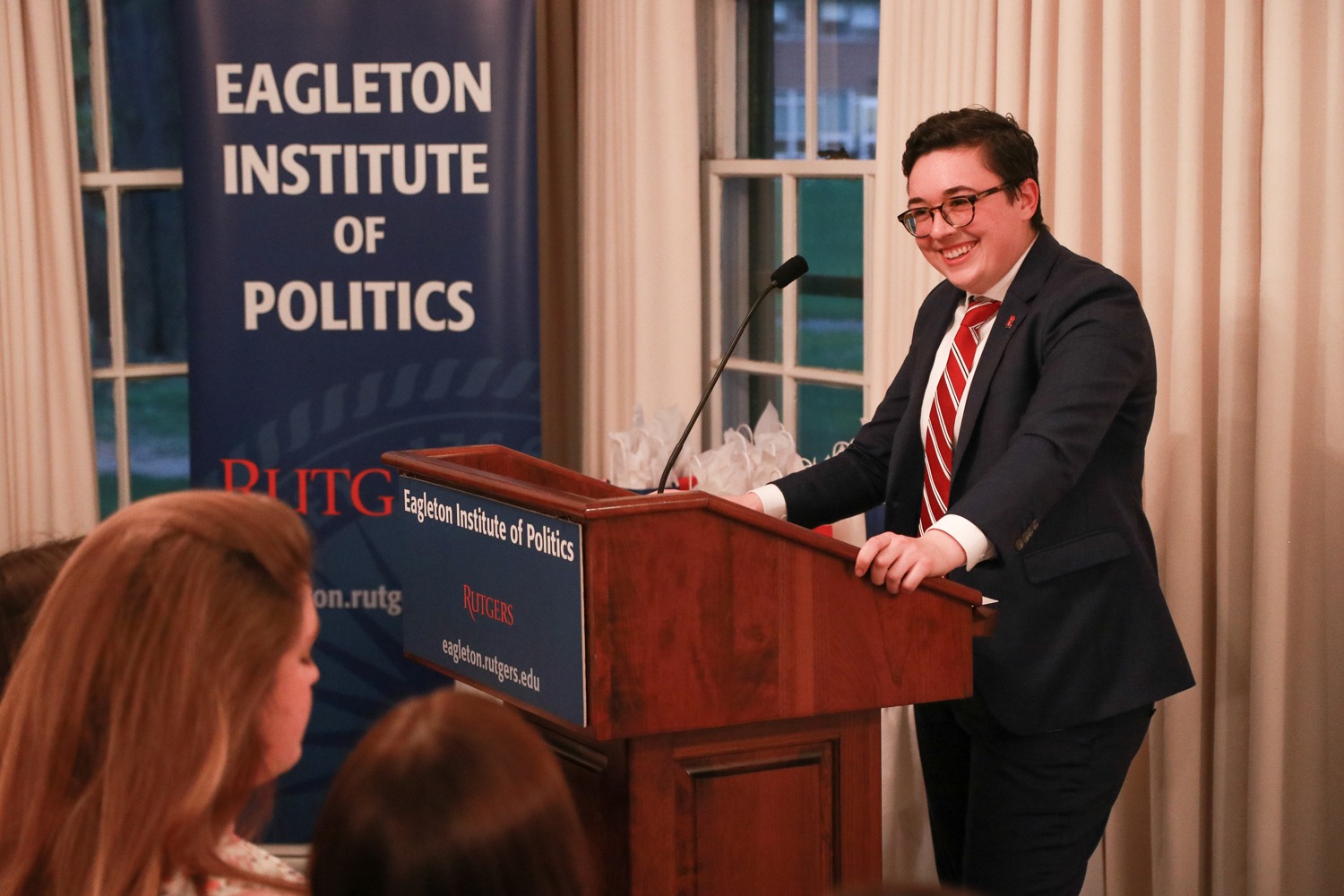
Class representative Alex Lleras at Fellows Closing Program
The Eagleton Graduate Fellowship is open to graduate students from all departments and schools on any Rutgers campus who are interested in politics and government. Recent Fellows have represented more than 45 departments in the social sciences, humanities and natural sciences, and 20 different graduate and professional schools reflecting a wide variety of interests and perspectives.
Eagleton Fellows work toward their graduate degrees without interruption; the one-year fellowship is designed to complement academic study. Throughout the year, students are provided direct access to practitioners in state and national politics and government. These connections help to bridge the gap between the academic training of a graduate student and the everyday challenges of a life in politics and public affairs. Eagleton fellowships expose students to the art and politics of governing and to multiple aspects of public policymaking while providing meaningful assistance to government.
All Fellows take the Perspective in American Politics courses in the fall to expand their knowledge and prepare them for an internship placement in the spring. For their internship, Fellows are placed in government offices and agencies at the state (legislative and executive branches), federal, regional, county and municipal levels.
“Throughout my graduate studies I have learned extensive details regarding Medicare and Medicaid policies. I have written many policy briefs… I thought I had a good understanding of health policy in the United States. I was wrong. After interning at the Medicaid office, I have learned more than I did throughout my graduate course work.” – Mariam Rashid, Eagleton Fellow
The Eagleton Graduate Fellowship is open to graduate students from all departments and schools on any Rutgers campus who are interested in politics and government. Recent Fellows have represented more than 45 departments in the social sciences, humanities and natural sciences, and 19 different graduate and professional schools reflecting a wide variety of interests and perspectives.
“The biggest highlight of the Eagleton Fellowship has been the diversity among fellows in our professional and political backgrounds.” – Brandon Pugh, Eagleton Fellow
Stipends and Tuition Remission
Up to 27 Fellows are selected annually and are supported through four financial awards:
Harold and Reba Martin and Eagleton Alumni Awards: stipend of $6,000 plus full remission for tuition and fees for the academic year
Eagleton Alumni Award: stipend of $6,000 plus full remission for tuition and fees for the academic year
Henry J. Raimondo Legislative Awards: stipend of $8,625 plus up to $8,625 in tuition credit for the academic year
Governor’s Executive Awards: stipend of $8,625
Courses
“I cannot imagine a better place to learn directly from people who have been involved in politics in so many different capacities.” – Kyle Holder, Eagleton Fellow
Open to Eagleton Graduate Fellows only, the Perspectives on American Politics is a seminar class that looks at current and historical practices and trends in American politics. The course discusses political theory and applies practical realities to current affairs. The seminar provides factual and practical insights as the basis for free, respectful and open discussions. The seminar relies on readings and presentations by prominent practitioners, guest speakers and experts. Course success is rooted in the active and respectful participation of all class members.
Course Learning Goals:
Through readings, classroom discussions, assignments, and guest speakers, students will:
Foundational Knowledge: identify and understand the core institutions, actors, and processes in American politics.
Analytical Skills: analyze the role of media in shaping political perspectives, recognizing bias, credibility, and diverse viewpoints.
Diverse Perspectives: identify the role of various identity groups (based on race, gender, class, etc.) in shaping American political outcomes and policies.
Application & Intergration: apply concepts learned to current political events and debates, demonstrating an understanding of the broader implications.
Civic Engagement:
recognize the importance of civic participation and how individuals can influence political outcomes.
formulate informed arguments on political issues and engage in constructive debate.
Ethical Reasoning: evaluate political decisions and policies through an ethical lens, considering implications for society, equity, and justice.
Communication Skills: effectively communicate their understanding of American politics in both written and oral formats.
How to Apply
APPLY NOW for the 2024-2025 Eagleton Graduate Fellowship Program. March 25th at 5:00 pm EST is the deadline for applications and recommendation letters.
Application Sections
Submitting your application for the Eagleton Graduate Fellowship Program is a three-step process:
Attach resume, unofficial transcript and essay to application form.
Applicants will not receive an immediate email notification acknowledging receipt. Eagleton staff will email applicants when their application packet is processed. The three (3) letters of recommendation should be sent to Eagleton directly from the recommender. Receipt of recommendation letters will be confirmed with applicants and recommenders via email. Application and recommendation deadline is Monday, March 25, 2024 5:00 pm EST. This is a strict deadline.
Essay/Statement
In 300-500 words, your essay/statement should answer the following questions:
Why you want to participate in the fellowship program?
What makes you a strong candidate?
What has prepared you for this fellowship?
What are your professional goals?
How do you think this program will help you meet those goals?
Your essay must be attached to your online application as MS Word or Adobe PDF document.
Letters of Recommendation
Three (3) letters of recommendation must be submitted in support of your application. Letters should be written by those who can speak to your academic qualifications and/or relevant experience for the Eagleton Fellowship program. You will need to list the names of your recommenders on the application.
At least one letter should come from a faculty member, preferably at Rutgers. If you are a transfer or new graduate student, then you can use professors from your previous college/institution.
Letters should be addressed to “Fellowship Selection Committee” and emailed as MS Word or Adobe pdf directly from the recommender to fellows@eagleton.rutgers.edu. Recommendation letters sent from the applicant will not be accepted. Paper recommendation letters are not accepted.
All recommendations received by Monday, March 25, 2024at5:00pm EST will be added to application packets and reviewed by selection committe. Letters recieved after that date will not be considered. You will be notified by email when your recommendation letters have been received and processed at Eagleton.
Selection Criteria
The selection committee reviews applications using the following criteria: demonstrated interest in government, politics and/or public affairs; academic performance; the quality of the essay and the applicant’s purpose for applying to the program; and letters of recommendation. Overall GPA is considered as part of academic performance. There is no “minimum GPA” in order to apply, but Fellows selected usually have a cumulative GPA of 3.2 or higher. All applicants must be accepted into a graduate program at Rutgers University to be eligible. Students must be enrolled full or part time from September 2024 to May 2025. Students in one-year graduate programs are encouraged to apply. Preference is generally given to applicants who are further advanced in their graduate program. Students in multi-year graduate programs (i.e., law, PhD, etc..) are generally not accepted for their first year of study.
Application Process
Applicants will receive an email confirmation when their packet has been processed at Eagleton and recommendation letters received. Letters of recommendation are confidential between the recommender and the Eagleton selection committee. Applicants cannot request to view the letters.
The selection committee will decide on candidates to interview who will be contacted via email. Henry Raimondo Legislative award candidates will complete a second interview in their legislative placement office at the State House before fellowship awards are made. The fellowship cofort is not finalized until all candidates confirm thier acceptance.
Students will receive preliminary notification of fellowship status by email by during the first week of May 2024. Henry Raimondo Legislative and Governor’s Executive fellow award recipients will receive final confirmation of fellowship awards when the New Jersey state budget is approved in late June/early July.
Frequently Asked Questions
What is the structure of the fellowship?
The Eagleton Graduate Fellowship is a one-year interdisciplinary certificate program. Graduate Fellows complete a course in the fall and government intership in the spring. The required course meets weekly in person on Friday afternoons at Wood Lawn, Rutgers-New Brunswick. Fellows spend 14 hours per week (2 days) at government office internship during the spring semester.
In addition to coursework and internship placements, Fellows participate in a series of events and sessions throughout the year, including an opening program meet and greet, monthly seminars, placement orientation, a two-day trip to observe the Maryland Legislature, Eagleton public programs and sponsored events, and a closing program graduation. Fellows also reflect on their spring placements through monthly journals and presentations. Detailed requirements available upon request.
When am I eligible to apply?
Eagleton Graduate Fellows work toward their graduate degrees without interruption; the one-year fellowships are designed to complement academic study. The program is only open to registered graduate students at Rutgers University. You can apply at any point during your graduate studies and multiple years, as long as you are enrolled full-time or part-time for the fall and spring semesters. Transfer and International students are eligible to apply. Students applying for the 2025 cohort must be registered full or part time in any Rutgers graduate school during the fall 2024 and spring 2025 semester.
What majors are eligible for Eagleton Fellowships?
The Eagleton Graduate Fellowship is interdisciplinary – students from all majors and all Rutgers University campus locations are eligible. Previous Fellows have represented a wide variety of graduate majors including: agricultural and food resource economics, anthropology, art history, atmospheric science, biomedical engineering/sciences, business/administration, chemistry, civil and environmental engineering, communications, childhood studies, city and regional planning, criminal justice, cultural heritage preservation, ecology and evolution, economics, education, educational psychology, environmental science, exposure assessment, food science, geography, global affairs, history, journalism and media studies, landscape architecture, law, liberal studies, library and information sciences, management, media, microbiology and molecular genetics, music, neuroscience, nursing, plant biology and pathology, political science, psychology, public administration, public affairs, public health, public policy, social work, sociology, toxicology, urban systems, urban planning, visual arts and women’s and gender studies.
What are the program requirements?
Program requirements include:
The Eagleton Fellowship year runs from September to May. All Graduate Fellows must maintain a minimum 3.0 overall cumulative GPA.
Additional requirements include:
Fall Semester:
Class. 3-credit course Perspectives on American Politics (Fridays 1:00-4:00 pm at Wood Lawn)
Meet & Greet (September)
3 Monthly Sessions (one Friday each month September-November)
State Government Orientation (December at State House)
Fall Networking event
Spring 2024 Semester:
196-hour internship in a government office. Two (2) 7-hour days per week for spring semester (January-April)
Placement process: Internships are arranged through individual conversations in fall. Raimondo Legislative award internships are set in May.
4 internship journals (due end of each month January-April)
Shadow a legislator, commissioner, or high-level government official for a day (February-April)
4 Monthly Sessions (one Friday morning each month at State House in Trenton, January-April)
Maryland Legislature trip (2-day trip in late February/early March)
RU Runing? or Ready to Run campaign training (February/March)
Program Graduation (May)
What are the fellowship awards/classes/internship opportunities?
The Eagleton Graduate Fellowship Program is made possible by four funding sources. Fellowship awards include Henry J. Raimondo Legislative Award, Governor’s Executive Award, Harold and Reba Martin Award, and Eagleton Alumni Award. All Eagleton Fellows have the same basic requirements (fall class and spring internship). All awards provide a stipend with varying levels of tuition support. There are diverse internship opportunities available at all levels of government.
Henry J. Raimondo Legislative Awards:
This award was initiated by the New Jersey Legislature and Rutgers University to honor the memory of Henry J. Raimondo (1947-1999), who served as associate director and professor at Eagleton. Eight (8) Raimondo fellowships are awarded annually. Raimondo awards provide a stipend of $8,625 plus up to $8,625 partial tuition credit for the academic year. (Awards are contingent on funding in the New Jersey State Budget.)
These fellows complete internships in the NJ State Legislature during the spring semester. Four fellows are placed with the partisan offices in the New Jersey legislature- one each in Senate (Democratic and Republican) and four are placed with the non-partisan Office of Legislative Services.
Governor’s Executive Awards:
This award is supported by the New Jersey Office of the Governor. Twelve (12) Governor’s Executive fellowships are awarded annually. Governor’s Executive awards provide a stipend of $8,625. (Awards are contingent on funding in the New Jersey State Budget.)
During the spring semester these fellows are placed in state of New Jersey government departments or agencies, including the Governor’s office, department administrations, boards and commissions.
Harold and Reba Martin Awards:
The Harold and Reba Martin Fellowship Award was established in 1981, when Harold Martin, former Bergen County Assemblyman, and his wife, Reba, made their first generous donation to the Institute. Six (6) Harold and Reba Martin fellowships are awarded annually. These fellowship awards provide stipends of $6,000, plus full remission for tuition and fees for the academic year.
Spring placements are determined by the Graduate Fellows’ interests in government and can be at the municipal, county, state, regional or federal government levels in New Jersey or other states.
Eagleton Alumni Award:
Eagleton Alumni Fellowship Awards are made possible by generous contributions from education programs alumni and friends. At least one Eagleton Alumni fellowship is awarded each year. The Alumni award provides a stipend of $6,000, up to full remission for tuition and fees for the academic year.
Spring placements are determined by the Graduate Fellows’ interests in government and can be at the municipal, county, state, regional or federal government levels in New Jersey or other states.
Alumni
There are more than 1,200 alumni of the fellowship program since the first class graduated in 1958. Some choose careers in public service and politics while others apply their sophisticated knowledge of government and politics in the private and non-profit sectors or in business, education, law, politics, advocacy or a variety of other fields.
The Institute has a strong alumni network, with many graduates involved as internship placement supervisors, guest speakers, and members of the Eagleton Alumni Committee.
Eagleton Undergraduate Associates learn about real-world politics and government from experienced practitioners and faculty. Rutgers University juniors from any school or major are eligible to apply for this selective three-semester certificate program.
Ready to Run® is a non-partisan campaign training program to encourage women to run for elective office, position themselves for appointive office, work on a campaign, or get involved in public life in other ways.
The Eagleton Science and Politics Fellowship offers PhD-level scientists and engineers the opportunity to apply their scientific training and expertise to the development and implementation of relevant state policy.